
Broken In By Horses
I was no more qualified to tend those fifteen horses than I was to write two novels, but I did it anyway, because I enjoyed it. Also, no one else was jumping for the job. It was poor pay and worse conditions – sweaty, stinky, sticky work (the horses, not the writing).
But I loved it.
Once my teaching position paused for the summer, I began making the daily drive to Horace’s barn, wearing a pair of Georgia workboots, cut-offs, and an old tank top. There, I fed, watered, and groomed his equine menagerie.
First, the hay.
Horace brought in huge rolls of sweet hay on a flatbed truck, then moved them to locations around the property with a forklift. I pulled off armfuls and carried them to each paddock, dumping the piles away from puddles and manure. Often, hay was leftover from the day before, but once it was trampled, the horses didn’t want it. Always, new hay.
Next, the grain.
Each horse was given a different amount and type of grain – food for old horses, new horses, fat horses, thin horses. Some got one scoop, some got two, some got one scoop of one grain and another of a different grain. I had a cheat sheet to remember it all, and the orders changed, as a horse got too heavy or too light. I watched to make sure they didn’t steal each others’ grain; they were bad about that.
Third, the water.
I dumped and refilled hot-tub-sized troughs, bleaching and scrubbing where necessary. Some of the horses liked to play in the water, and they dirtied their tubs each day. Others were neat and polite, and I appreciated that.
Finally, if there was time, I groomed them.
I curry-combed whoever hadn’t been brushed lately, braided manes, de-tangled tails. Horace showed me how to use the hoof pick to remove debris and how to stand so I didn’t get kicked. I tried to check each horse weekly.
It was a full immersion course in horsemanship, mostly taught by the subjects themselves, and they were great teachers.
I’m currently reading the novel Horse by Geraldine Brooks (which I like so far); Brooks highlights how unique an individual animal can be. This was especially true at Horace’s, where nearly every breed was represented.
Horace, bless his dear heart, collected horses like they were rare stamps. He strove to own one of each kind and kept them tucked away in paddocks where he could look at them when he pleased, taking his favorites out for a ride every few months. His interest was possession, not interaction. That was my job, and I believe I got more enjoyment from his collection than he did.
I’ll tell about the horses at the front of the property in this post and those toward the back in the next.
In the paddock closest to the road lived Sugar and the colt, Phoenix, and I’ve already told their story. They remained happily together for the entire three years I visited them. Theirs was the best pen, which wasn’t really fair, but I’d have given that baby horse anything.
Over time, Phoenix grew, as foals will, and I brushed his coat and mane, taught him to accept a halter, and accustomed him to having his feet handled. When it came time to attach the halter to a lead line, he fought it like a wild bucking bronco. But he was still small enough that he lost, though it took all my strength, both physical and emotional, to hold the end of the rope while he struggled. Why can’t they just stay babies?
Next to Sugar and Phoenix were three mares in a large paddock. Much like human females, mares often don’t get along, but these three managed with minimal conflict. They nipped, pushed, and fussed, but they didn’t try to seriously hurt one another. One of the mares was a mustang, and the other two were paints. “Paint” means they had blotches of brown or black in their coats – very cowboy, very pretty.
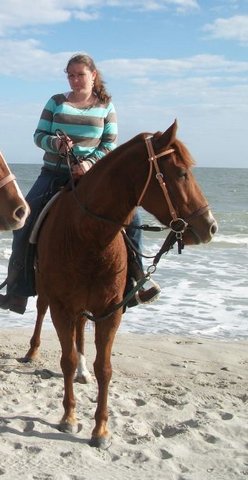
One of the paints was “my horse,” which I rode during those years at Horace’s (the picture at the beginning of this article is another horse). My horse was gentle and wise; she could’ve been a trail mount for children and nailed it. I knew next to nothing about riding, but she made it easy. The other two paints were interchangeable, and Horace said they were as well trained as mine. Then one day, another paint mare showed up, and there were three paint sisters in that pen.
And one mustang.
She’d come from a wild population in Corolla, on the NC Outer Banks. “Mustang Sally” had never been broken, and she thought I was the devil in disguise.
While I brushed the other mares’ manes, cleaned their feet, and checked the wounds they gave each other, the mustang kept at least three arms-lengths away. She had a supernatural awareness of my location at all times.
Horses, you see, are prey animals. They’re large and imposing, regal-looking at times, and weigh around a ton. Their hooves and teeth are knife-sharp, their haunches powerful (thus the term “horsepower”), and they can outrun an Olympian. Yet they are afraid of everything.
Blowing leaf? Terrified. Stick on the ground? Probably a snake – better rear up and panic! Someone sneezed? Run away and don’t stop until you reach the next county!
They are ridiculous animals; I fail to see how we came so far as a society riding on their backs.
The trick to working with horses is to make them feel safe. Give them clear, consistent direction, use a firm touch, stay calm and steady, move slowly and visibly, and don’t, for goodness sakes, act like a hungry mountain lion.
Since the mustang had lived wild, it was harder to gain her trust than Phoenix’s, and haltering her took me the better part of a year.
First, I touched her tense shoulder, glancing fingers along her mane and resting my hand on her back. Bit by bit, my hand moved along her body, toward a leg, to her rear, to her face. Eventually, she let me brush her. But still, at the least movement from me or one of the mares, she darted away at full speed.
Then, one day, after a long session of brushing, I slipped a rope halter over her head. I didn’t even hold onto it, just let her dance off wearing her new accessory. Seeing her in that twist of purple rope made me so proud.
I’m not sure which one of us was caught.

 Jessi Waugh Writer
One thought on “All the Horses”