Handmade World
You’d recognize it at a glance, even if you don’t subscribe, don’t read it, or don’t even like it (How is that possible?) The magazine with the yellow border – the one with the naked people, the one from your childhood. National Geographic, may it never go out of print.
I’ve been a subscriber since before I could afford it. Other magazines have come and gone (you were too expensive and dry, Scientific American), but NatGeo remains.
National Geographic Magazine was first published in September 1888. Just when you thought the nineteen eighties sounded old, here comes a relic of the eighteen hundred and eighties, looking as fresh and relevant as whatever’s trending on TikTok these days.
Dare we say the word timeless? Your grandparents had a stash of NatGeos, your teacher, your weird neighbor. Holding one of these magazines is, in itself, a connection across time.
If you’ve been reading NatGeo these last several years, you’ll have noticed Paul Salopek’s “Out of Eden Walk” articles. Since the beginning, I’ve looked forward to these, and I have enjoyed them all.
This month’s issue was dedicated to Exploring, and Salopek is an explorer – traversing the path of human migration on foot, from Africa’s Great Rift Valley, through the Middle East, the Silk Road trade routes and “-stans,” to India and China. He has plans to proceed north, across the now-flooded “land bridge,” along the west coast of the Americas, and end his journey at the tip of South America.
The crazy fool. I hope dearly that he makes it.
His writing is touching; it makes me envy his eyes. This month’s “A Handmade World,” from his walk through China, was especially memorable – it contrasts the older parts of China with the new, finding the modern world lacking.
Salopek speaks of homes built to their occupants’ heights, walls not plumb but sturdy, farm plots undulating with the mountains, streets as narrow as a human armspan. He says, “It was an architecture that revealed a single human life, not a demographic of millions.”
Think of some human-made place where you felt connection, a sense of belonging and comfort. Was it built by a machine or made to fit its exact landscape and the needs of its people? What do machines know of beauty?
“…it was only in [the places with handmade architecture] that I felt invited to lay my open palm on the face of another human being.”
I can only imagine that while hiking across the world, human connection would be important. No less important than it is for the rest of us, caught in our individual lives. Salopek finds that sense of connection even in the absence of others, when he comes into contact with handmade homes, farmlands, roads, and objects that speak of their makers and their work, played out in concert with the landscape over time.
National Geographic is like that – it’s the product of over a hundred years’ relationship between its readers, writers, and producers. It’s grown with the people, been tailored to fit the photographers, the explorers, and their audience. The fit didn’t come all at once or without growing pains. It took time; it took people.
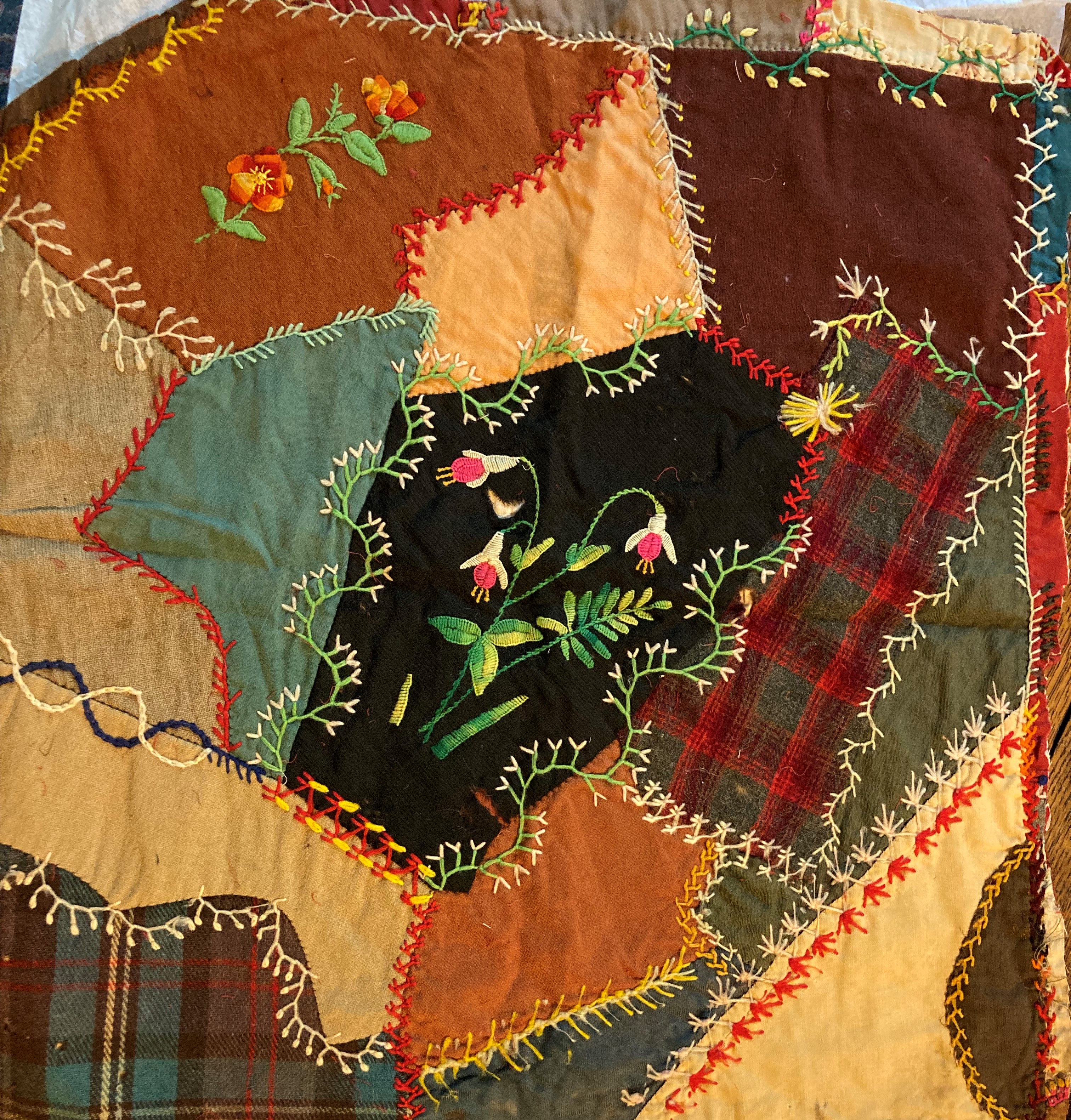
The quilt at the beginning of this post was made by my grandfather’s grandmother, my great-great-grandmother. It’s a crazy quilt, one with a random assortment of fabrics, sizes, and shapes. Many of the pieces are embroidered with flowers, and each piece is connected to the others with embroidered designs – geometric and floral – some that look like they’ll jump off the quilt and into real life. And with them, their maker jumps from the quilt as well.
My son is currently sewing pockets. He saw me making superhero wristbands for his brother, a project I’ve been putting off for months. He remembered hearing one of our adult friends say she wished she had pockets in her dresses; she’d love someone to invent the add-on pocket.
So he’s inventing it, hand-making pockets of red felt, sewed together haphazardly with a needle and thread. You can look at those stitches and feel his small hand. What he invented wasn’t a pocket but a piece of himself, for someone else to carry. Like his great-great-great grandmother’s quilt.
National Geographic is undergoing a transition. It is laying off its full-time staff writers, replacing them with freelance writers. This is an industry-wide trend – arguably to make publishers more flexible and diverse, but at the cost of writers’ careers, job security, and relationships with their publications.
Some of the staff writers have been there over thirty years, longer than I’ve been reading NatGeo. Will those just passing through be able to give the magazine its well-loved and well-tended sense of handmade quality and connection?
I hope so, because that’s just what our world needs.
by Jessi Waugh

 Jessi Waugh Writer
Wow! This is such a compelling piece of writing, Jessi! I love how you’ve managed to weave in so much so gracefully – the magazine’s history and your personal history with the magazine, handmade artifacts in China and your cherished quilt and your son’s pockets and the value of individual writers in a mechanical world. Soooo good.
LikeLike
Very sweet of you to say so, Autumn!
LikeLike