
Enmarshed
Enmarshed is the best kind of word – the made-up kind. It’s also a stolen word, filched from my friend Autumn Ware’s blog, which only adds to its appeal.
What does enmarshed mean? Intertwined, connected, with many pieces making up a whole (Jessi’s Dictionary).
A net is enmarshed. In fact, “marsh” is a local term for the mesh that makes up a fishing net, and I should have a citation for that claim, but I can’t find it. I even asked David Cecelski, who knows everything, and he recognized the term but not a source. I’ll work on that, dear reader.
Marsh is an old word, from the last century and before, when nets were handwoven of cotton or hemp, knit by fishermen and their wives, mended a hundred times over. The rope was made strong by its weaving, made resilient by its enmarshing.
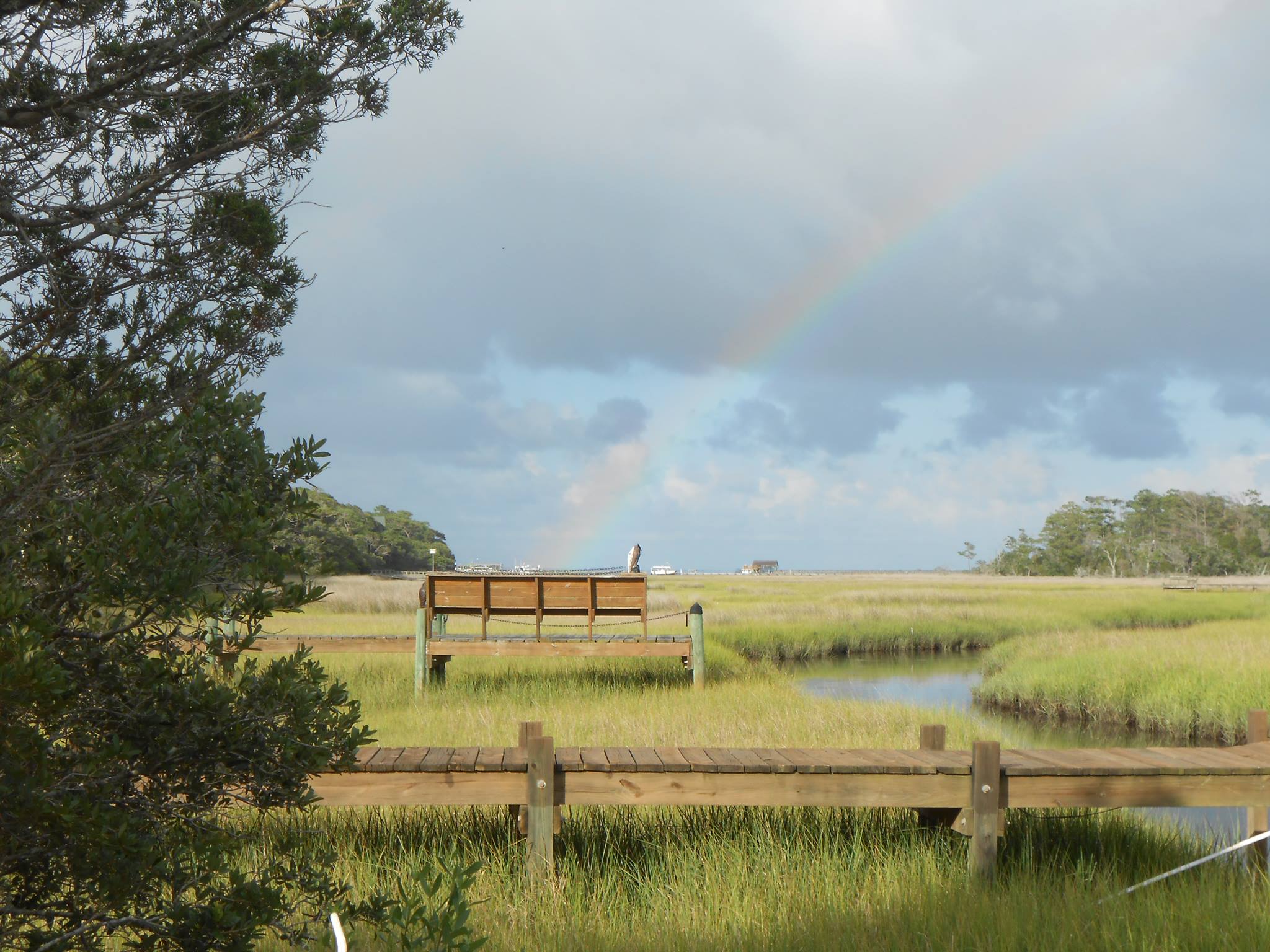
Like your brain – all those neurons shooting signals to produce movements and memories, working together in a web of thought to read and process this sentence. Or the marsh itself, of course, the cordgrass and needlerush roots interlocking to make a spongy bed. Those roots hold the marsh in place during changing tides and storms, bound together like the worst knot you ever tried to untie.
We had a hurricane recently, and the wind was raging. I walked along our sound-side neighbors’ driveway, which is bordered in coastal forest – that means vines, lots of vines. The trees and bushes weren’t hardly moving at all, they were so entangled in the vines’ stabilizing embrace. Vines enmarsh, too.
Coastal vines include catbriar, jessamine, muscadine grape, summer grape, poison ivy, English ivy, wisteria, blackberry, peppervine, honeysuckle, trumpet creeper, wild pea and bean, morning glory, even a native passion flower. It would be impossible to exaggerate how much of the local biomass consists of vines. It’s the net criss-crossing our land, and we are its catch.
My husband and I rented my dad’s beach house when we were first married. It sat on a hill in Emerald Isle, NC – a 1970s A-frame from which we could see both sound and sea. I’d lived there with my dad part-time growing up; it was a cool house with a terrible yard.
The yard was at the bottom of the hill, on the side closest to the beach. It consisted of sandy soil, speckled with a few tufts of grass, yuccas, sandspurs, prickly pear cactuses, and Smilax (catbriar) vines.
One time, when I was young, I walked into that yard barefoot in the late summer. I got ten steps in and couldn’t go any farther, spines and spurs densely wedged into my feet and ankles. I cried until my father picked me up, soaked my feet in an ice bath, and plucked the prickers from my feet with tweezers, one by one. There were so many.
In revenge, I decided to tame that rowdy yard.
I pulled out the prickly pears by hand, grasping their spineless bases below ground level. I dug up the small yuccas. I mowed often, to stop sandspurs from developing. And I tackled the catbriar.
The catbriar was on the hill, which was hard to mow, but even with mowing, it sprung back a day later from its underground tubers and shoots (rhizomes). There’s only one way to get rid of catbriar, and that’s to dig up the tubers and all the rhizomes, careful not to leave even a pinkie’s-worth of root in the ground, since it will sprout more shoots.
I dug up tons and tons of catbriar. Some of the tubers were as big as my head, some shoots connected ten feet or more underground. They were thorny, tough, and stubborn, but I won. I got every bit of catbriar out of that hill.
And afterwards, there wasn’t much of a hill left. It had been made of catbriar. If you take away the enmarshing, not much remains.
It’s like dark matter and energy – together they make up 95% of the universe, the matrix that supports the rest. Or the interstitial space between cells – we used to think it was pointless and empty, now we realize it affects the cells; they’re enmarshed with it. Cells communicate through the space with chemical signals, and the space itself communicates back.
Or trees in a forest – they send similar signals along roots and mycrorrhizae, sharing nutrients and talking, in a way. Or interrelationships between organisms in any ecosystem, intricate food webs where all relationships contain some level of symbiosis.
Sorry, I got carried away.
Back to Autumn. She started a website, EPIC Carteret, where I contribute a monthly post about nature. EPIC is devoted to the local partnerships that make life better for everyone, that support our town and its people. It’s an ode to connections, to the marsh that binds us. We build upon each other, we hold each other steady in a storm, we send help, we listen. Autumn calls this “mutual fruitfulness.”
Whatever you call it, we are inextricably, incredibly intertwined. Thanks for the support, reader – I hope to one day return it.
by Jessi Waugh

 Jessi Waugh Writer
Awwww, I love this!!! And not just because my name is in it a couple of times, which is almost always going to make me a fan. I love how you’ve taken this made-up word and enmarshed it in a whole web of viney ideas to define it. You’re such a smart cookie.
LikeLike
Thanks for inventing the word!
LikeLike