
What doesn’t kill you
These blog posts could be considered memoir, and I’ve heard it said that memoir should be 90% truth and 10% lies.
What part isn’t true? The part that you don’t like, of course, I promise. Whatever part you find most offensive, disturbing, or unbelievable – that’s the 10%, so just relax and enjoy the rest.
It’s like a “Get Out of Jail Free” card for the writer. What? Jail? Have I ever been in jail? Maybe, but that could be the 10%. See? It works beautifully.
Another rule comes from The Memoir Project, a how-to for writing about life. It gives the formula: “The story is about x as illustrated by y.” This means that each essay should center on a certain theme (“x”). No reminiscing for sentiment’s sake; all stories must have a point.
This week’s x: appreciating what you have.
Like central heat. As the temperature outside decreases, my appreciation for our HVAC system increases. What a wonder of modern life. If I want the house to stay seventy degrees when it’s forty out and dropping, it does. Which is even more wonderful because not all the houses I lived in had central heat.
It’s not like I live in Michigan. I’m in North Carolina, on the coast, warmed by the Gulf Stream. Yet that same ocean makes for bitter winter weather. There’s a wetness to the wind – ice crystals fly through the air. It turns your cheeks raw and seeps through dry clothes, to the sun-loving bones beneath. The wind can hover at twenty to thirty miles an hour from the northeast for days, peaking at fifty mph and above. Some of our worst storms are Noreasters, hurricanes during February, when it dips below freezing and stays there. I’ve heard tales of the sound freezing solid.
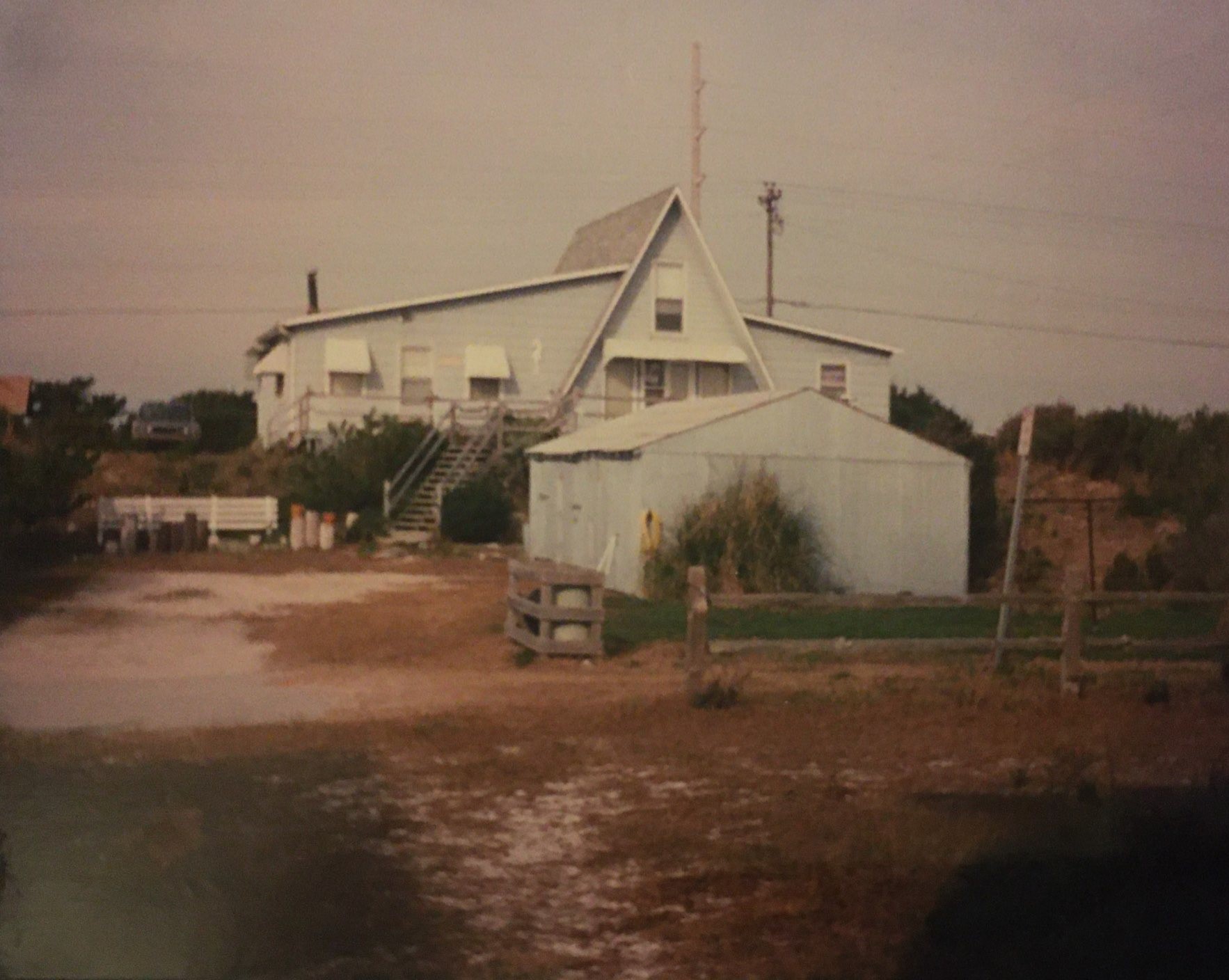
When I was about nine years old, my parents split, and my dad bought a beach house on a hill at the narrowest part of the island. From his roof, you could see the sound and the ocean; the wind whipped around that house like it was the Big Bad Wolf trying to blow it down.
The house was built in the 1970s, an A-frame that had been added on to over the years. The previous owners slapped additions onto the existing structure without even removing roof shingles from the newly interior walls. Or adding heat. Or flashing windows. Or using insulation. My dad accepted it as-is.
How do you stay warm without central heat? I’m sure many of you already know the answer; people have been doing it for centuries:
Hang thick curtains on the windows and debate covering them with clear plastic, restricting sunlight but keeping the cold air at bay. Shut up rooms that aren’t used often and never open the doors.
Drink hot tea, drink bullion, and eat soup for most meals. Hold your hands over the pot on the stove while dinner cooks, letting the steam tickle your fingers. When you wash dishes, run the hot water extra-long just to feel its warmth.
Take baths, draining and refilling the tub when the cold air under the house sucks away the water’s heat. Dress in the bathroom, in the steam. Don’t leave until you’re fully covered. When dressing dry, hover in front of a space heater, removing and replacing layers of clothes one at a time, as quickly as possible.
As a family, huddle around the largest, most effective space heater you own: a propane model or a gas fireplace, a wood stove or some hot-air-blowing electric contraption. Get close but not too close. Wear outwear inside. Don’t move much. Lay on the couch under a pile of blankets and only let your nose stick out.
Our biggest heater was a free-standing triple-burner propane unit, set on a circular street sign in the living room. We turned it three clicks up to its highest setting and sat on bean bags in front of the heater, in front of the TV, alternating locations to keep our extremities roasting evenly like rotisserie chickens. Ten feet away from the heater, it was crisp-cold.
When it was time to leave the living room, I rushed to my north-facing bedroom, with its old single-paned sliding glass door, where a small cubic plug-in heater warmed a five-foot cube of space. I pointed it at my bed and climbed in wearing a sweatshirt, flannel pants, and thick socks. Sometimes, I pulled up the sweatshirt’s hood. And there I read into the night, each hand in turn becoming an ice cube, then thawing under the covers.
But of course, this was the last century, and no one had central heat. Oh wait, no, that’s not true. It was the 1990s, and yes, they did, just not us.
My father says this made us tough: what doesn’t kill you makes you stronger, builds character. My mom must’ve been in on that character curriculum as well, because my bedroom at her house also lacked insulation and had only a space heater, the stand-up kind that looks like an accordion. It had a screw driven into the dial knob so it couldn’t be turned up past half-way. I could be warm but not very.
I have a friend who plans on living aboard a boat in the near future, so she’s leaving her central heat set low to harden herself against discomfort. We’re masochists and martyrs, when we do it to ourselves. There are others terms when we do it to our children.
Character building, right?
I recently read Last Stop on Market Street to my five-year-old, and though kids never appreciate this book, I think it’s a masterpiece.
A boy and his grandmother leave church and travel downtown on the public bus. The boy envies friends with cars and kids with music players; he laments his bad luck, stuck on a bus going to the run-down section of the city. When they arrive, there’s graffiti on the walls, decaying concrete, boarded windows, and the boy asks, “How come it’s always so dirty over here?”
Grandma answers, “Sometimes, when you’re surrounded by dirt, you’re a better witness for what’s beautiful.” And they step into the soup kitchen, to serve others.
Sometimes, you have to feel the cold to value spreading the warmth. Thanks, mom and dad.
by Jessi Waugh


I was thinking about our first winter on the Sea Shanti reading this. We all had to huddle up in Fain’s tiny aft-cabin – me, Jack, Fain, and two cats – with a tiny space heater to keep warm during one particular cold snap. Ice froze the louvered wood companionway doors completely shut. My child is for sure going to look back on his childhood as, er, character-building. It’s good to know you turned out okay in spite of the cold. Hopefully, he will, too.
LikeLike
I’m sure he has character coming out of his ears
LikeLike